VPS & MapSet is MultiSet’s drop-in replacement for Vuforia Area Targets, giving you 5-CM of localization accuracy & low drift with flexible on-device or cloud training, no rescans required.
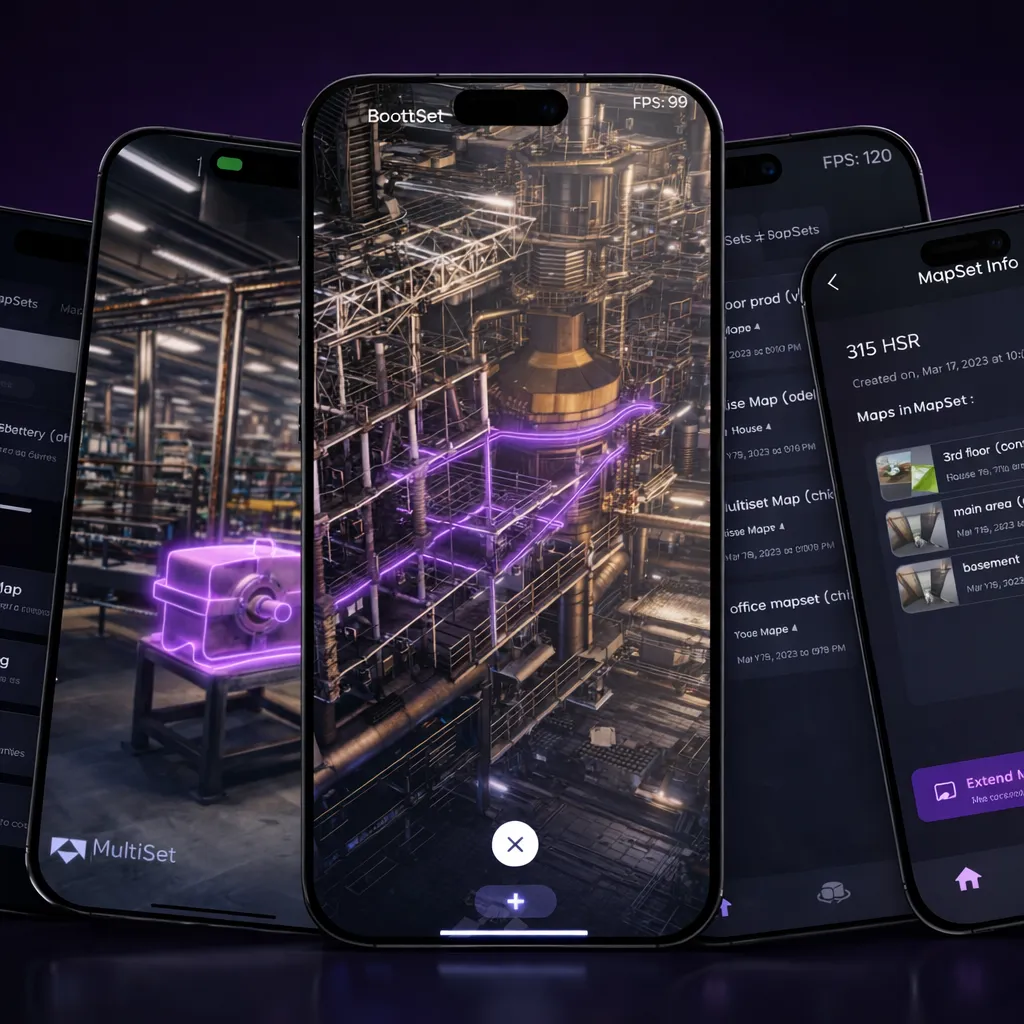
Re-scan with MultiSet iOS Mapper
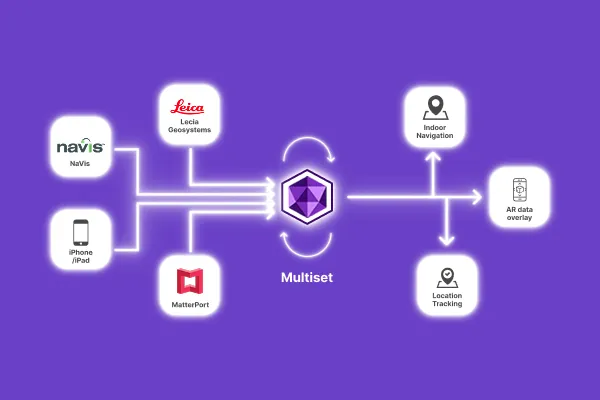
Import your original source scans
Every cell below describes what each product publishes about itself. Where a figure is not published, this says so rather than estimating one.
| Vuforia Area Targets | MultiSet | |
|---|---|---|
| Capture input | Approved scanners only | Any: E57, Matterport, NavVis, Leica, Faro, XGRIDS, Polycam, Gaussian splats, 360 video, phone LiDAR |
| Deployment | Cloud or on-device | Cloud, private VPC, self-hosted, on-device |
| Multi-floor stitching | Limited, separate targets | Yes, via MapSet |
| Re-scan without re-authoring | Rescan and rebuild | Yes, map versioning |
| Object tracking | Model Targets, trained per object | Markerless, from a CAD or scan model |
| Published accuracy | Centimetre-level within the target area | Sub-5 cm positioning, sub-millimetre object tracking |
Most teams are not rebuilding an application. They are swapping the localization layer underneath one that already works, and the useful question is what carries over.
What carries over: the Unity project, the scene graph, the interaction code, the UI, the content authored against your anchors, and the build and distribution pipeline. Localization is one component in the scene, and replacing it does not touch the rest.
What changes: the map. Area Targets are built from a supported scanner into a product-specific database. MultiSet ingests the source scan directly, so if you still hold the original capture the map is a re-process rather than a re-scan. If the source scan is gone, any scan of the space will do, including a phone capture.
What to budget: an afternoon to get one space localizing in a sample scene, then the real work, which is validating accuracy in your worst area rather than your best. Teams with several sites usually pilot one, confirm the numbers, then process the rest in a batch.
Where is the compute allowed to run? If public cloud covers it, the shortlist is wide. If the requirement is a single-tenant private VPC, an on-premises install or a fully air-gapped deployment, that is usually the constraint that decides the evaluation, and it is better established in the first conversation than at the security review.
What happens when the space changes? Ask specifically what a partial update costs and whether authored content survives it. A system where every layout change means recapturing the site and re-placing every anchor will quietly fall out of use inside a year, whatever its accuracy on day one.
The fastest way to settle both is to send one scan file and compare the result on your own space rather than on a demo.