Spatial AI for Retail Operations

Retail Planogram Compliance & Spatial Commerce

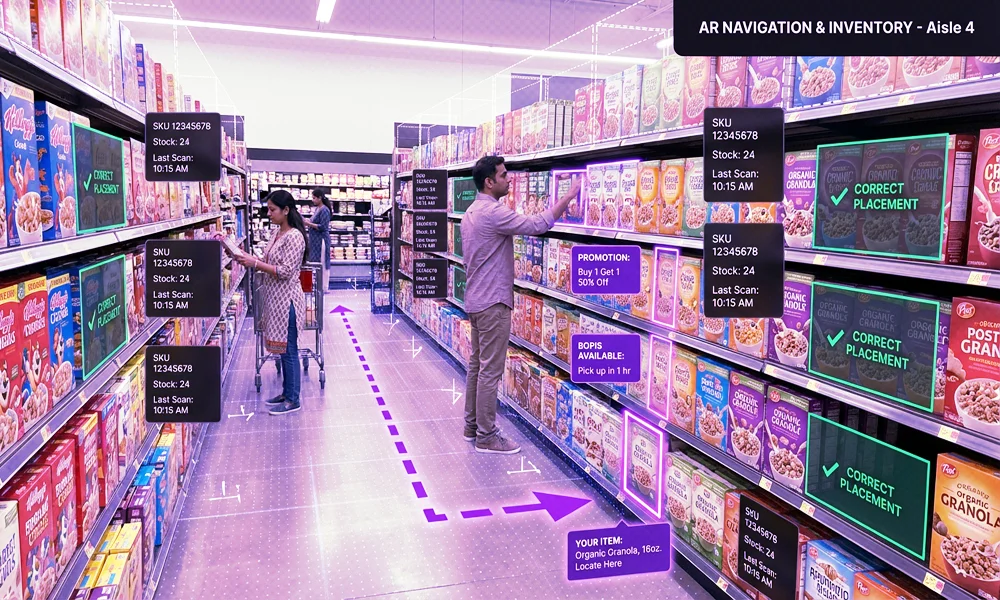
Align shelves, bays and SKUs to reality for automated planogram compliance, faster BOPIS and precise AR promos - at full store scale, even with crowded aisles.
Store-Scale Mapping
Whole-store anchors with bay/shelf semantics.
Low-Drift Relocalization
Stable poses in dynamic, high-traffic aisles.
Planogram-Ready
Works with XML/CSV planograms, PIM, POS and ESL.
On-Prem Privacy
Keep sensitive retail data local when required.
What is “Retail Planogram Compliance & Spatial Commerce”?
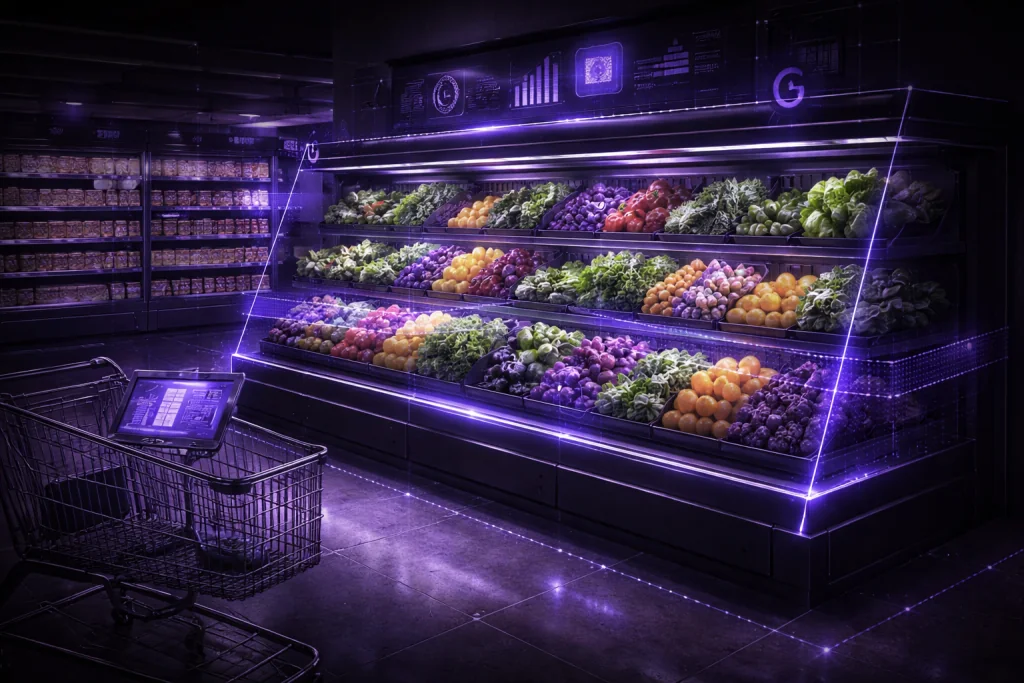
Planogram compliance is the check that what is physically on the shelf matches the plan the category team published: the right SKU, in the right bay, at the right facing count and the right shelf height. Most retailers still audit it by walking the aisle with a clipboard or a handheld, which is slow, sampled rather than complete, and out of date the moment it finishes. MultiSet anchors every bay and shelf to a fixed coordinate in a map of the store, so a photo taken by a colleague on a normal phone is automatically attributed to the exact bay it shows. The comparison against the planogram becomes a lookup rather than a judgement call, and the audit is a by-product of walking the store rather than a separate task.
Contact Us
Benefits & Measurable Impact
Faster Audits
Automate planogram checks and reduce manual walk-time.
Fewer Stockouts
Run SKU recognition and gap checks grounded to each bay; trigger tasks.
Quicker BOPIS & Accurate Promos
AR routes for BOPIS and precise promo placement; track audit time, OOS and pick speed.

Who it’s for

Built for high-volume retailers that need truthful shelves and efficient store execution.
Grocery
Convenience
Pharmacy
Big-Box
DIY/Hardware
Specialty Retail
How it works
Import & Capture
Load planograms and capture store geometry; define bay/shelf anchors.
Align & Audit
Run SKU recognition and gap checks grounded to each bay; trigger tasks.
Guide & Measure
AR routes for BOPIS and precise promo placement; track audit time, OOS and pick speed.
Frequently asked questions
What is planogram compliance?

Planogram compliance measures how closely the physical shelf matches the published plan: correct SKU, correct bay, correct facing count, correct shelf position. It matters because non-compliance shows up as lost sales the store cannot see. A missing facing does not trigger an alert the way an empty shelf does, and a product in the wrong bay is invisible to a shopper looking where the plan says it should be.

How do you audit planogram compliance without installing shelf cameras?

There are three ways to know what is on a shelf, and they differ mainly in what you have to install. Fixed shelf cameras and smart shelves give continuous coverage but mean hardware, power and maintenance in every bay of every store, which is why they usually stop after a pilot. Robots give good data on a schedule but are a capital purchase per store and only see what they pass. Camera-based auditing uses the phone a colleague already carries: they walk the aisle, and every image is anchored to the exact bay by visual positioning rather than by a guess at which shelf it shows. Nothing is installed, coverage follows the people already in the store, and the cost does not scale with the number of bays.

Do we need special shelf hardware or shelf-edge labels?

No. MultiSet works with the planograms, PIM and electronic shelf labels you already run, and SKU recognition can run on the device or at the edge. The positioning comes from the store's own geometry rather than from anything mounted on the fixtures, so a reset does not mean re-installing hardware.

How do stores handle resets and remodels?

A reset changes the shelf, not the building. Because anchors are held against the store's structure rather than against the products on it, a category reset usually needs no map change at all. A remodel that moves fixtures or walls needs a partial recapture of the zones that changed, and authored anchors carry forward across map versions rather than being re-placed by hand. Ask any vendor for that distinction specifically, because a system that needs a full recapture every reset will not survive its first year in a grocery estate.

What devices are supported, and does it protect shopper data?

iOS and Android mobile, Unity, WebXR and compatible head-worn devices. Shopper-facing AR can run through WebXR or a QR entry point with no app install. On data: deployment can be public cloud, private cloud or VPC, self-hosted or fully on-device, and only operational metrics are collected by default. For retailers whose store imagery cannot leave their own infrastructure, the on-premises and on-device paths exist for exactly that.