Press Release

Today we're releasing Gen2.5, the next generation of MultiSet's Visual Positioning System. It finds the right place in a map more often and answers the first calls on a map faster, with the same centimeter accuracy you build on. Every existing map on our cloud has already been upgraded, and your app and API integration stay exactly as they are.
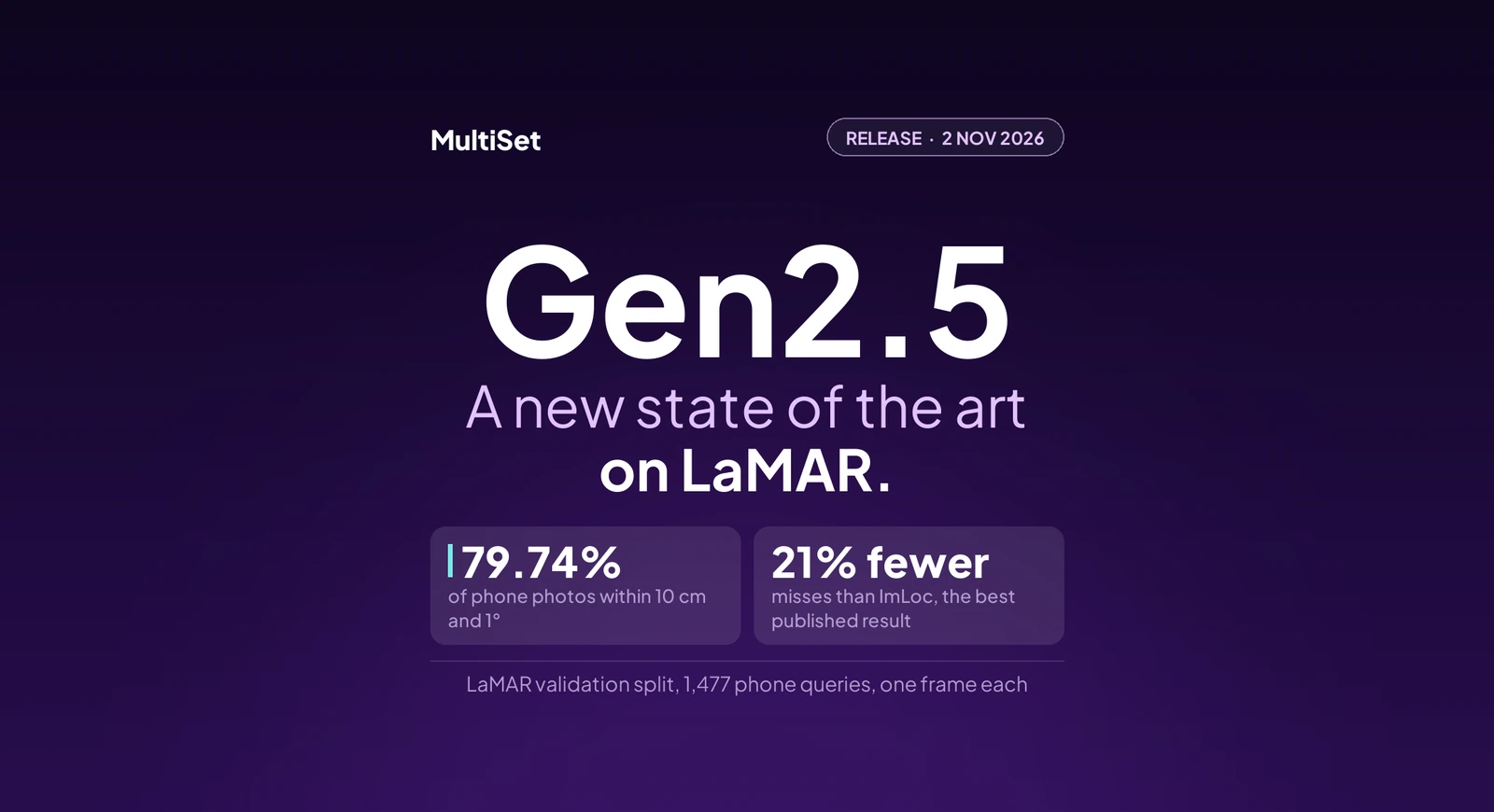
We also put it through a public benchmark. LaMAR is the localization benchmark ETH Zurich and Microsoft built for augmented reality, and on it Gen2.5 localizes more phone photos within 10 cm and 1° than any method published to date, a new state of the art (SOTA).
Benchmark. Averaged over LaMAR's three scenes, Gen2.5 localizes 79.74% of phone queries within 10 cm and 1°, from one photo per query. The previous best published result, ImLoc, is 74.24%. Gen2.5 misses 21% fewer.
Against Gen2. Through our production API, Gen2.5 localizes 2.0% to 4.0% more queries than Gen2 at an outdoor industrial site and at indoor transit stations. On harder evaluation sets the gain reaches 12%.
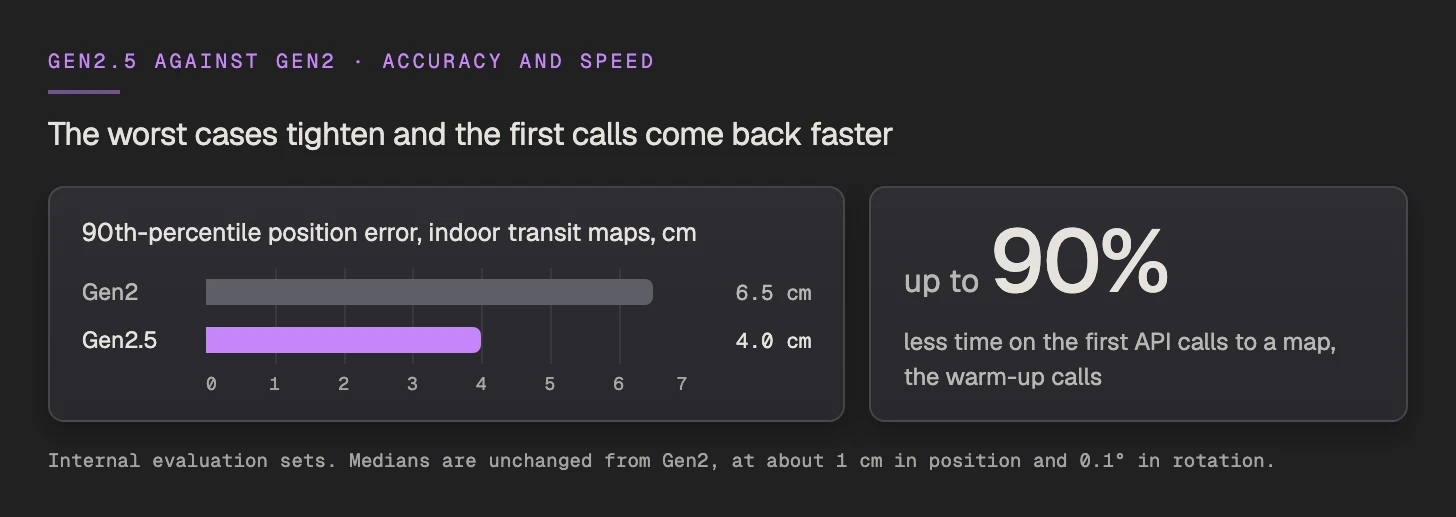
Accuracy. Median error holds at about 1 cm and 0.1°. On indoor transit maps, the 90th-percentile position error falls from 6.5 cm to 4.0 cm.
Speed. The first few calls on a map take up to 90% less time.
Every localization starts with one question: which part of the map is the camera looking at? Only once that's answered can we compute a precise position and orientation. If the system picks the wrong part of the map, or recognizes none of it, the query fails however good the rest of the pipeline is.
As customers have moved from single rooms to stations, campuses and industrial sites, that first step has become the bottleneck. Big spaces repeat themselves. Platforms are identical, corridors repeat, and the same equipment stands in rows. Field queries are rarely clean either. Teams capture from odd angles and through partial occlusion, often long after the map was scanned.
Gen2.5 rebuilds that step from the ground up. It's better at telling look-alike places apart, and it holds up when the query is taken in conditions the scan never saw.
LaMAR (Sarlin et al., ECCV 2022) was built by ETH Zurich and Microsoft to test localization the way AR devices actually meet the world. It covers three scenes in Zurich of 12,000 to 18,000 m² each, every one captured over about a year, through lighting changes, moving people, rearranged furniture and construction. Query sessions were recorded separately from the map sessions, often months apart, and the ground truth is aligned against laser scans precisely enough to score at 10 cm and 1°.
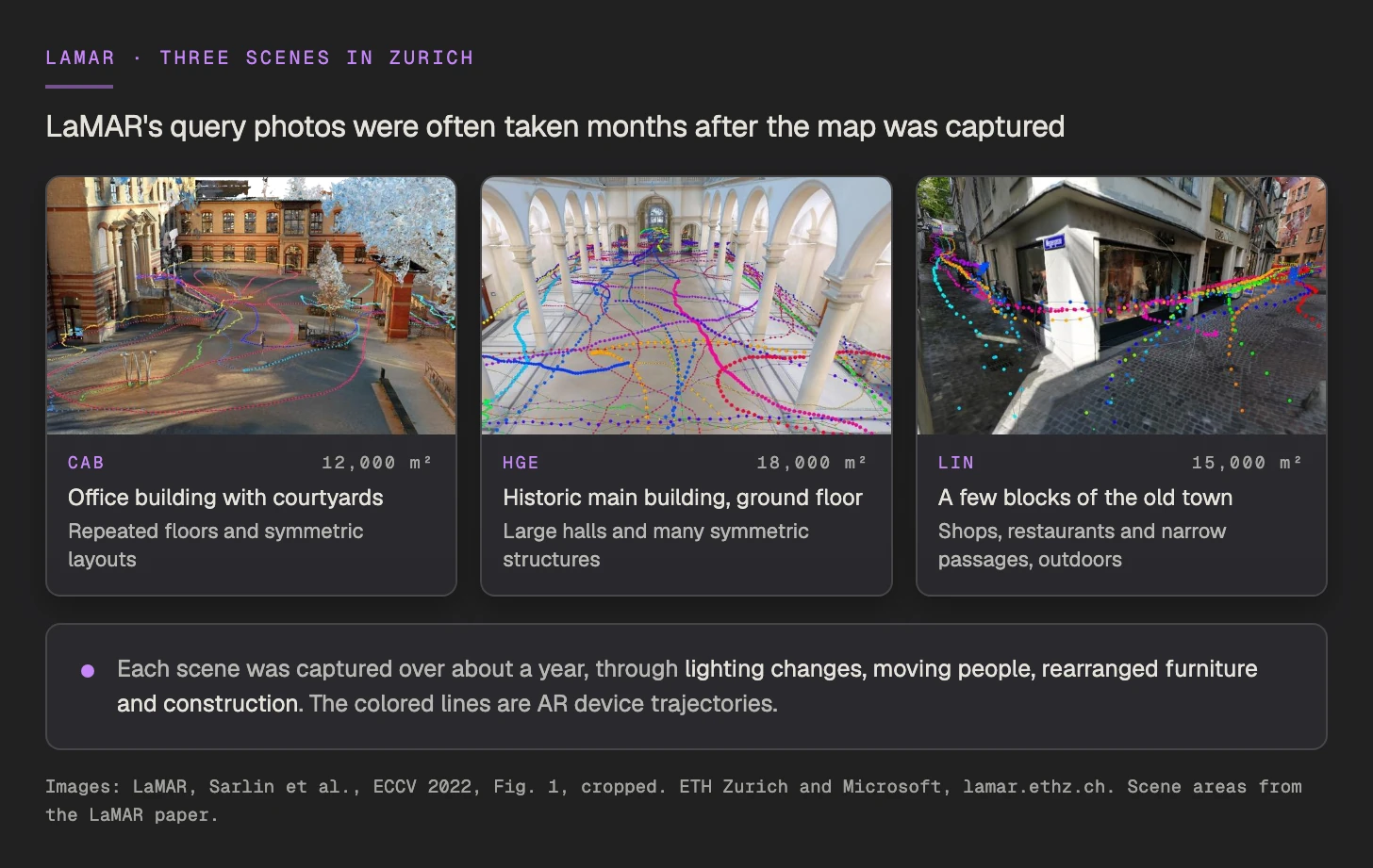
We picked LaMAR because it fails systems for the same reasons customer sites do. Repeated floors and mirrored halls are the look-alike problem Gen2.5 was built for, and the months between mapping and query are the time gap our field teams live with.
We ran it the way a customer would use us, with nothing the benchmark doesn't allow.
One photo per query. Each of the 1,477 phone queries went in as a single image, with Deep Search, our higher-recall query mode. There was no image sequence, no device tracking and no multi-frame fusion.
A map from the benchmark's own data. We built the MultiSet map from the images and laser scans in LaMAR's released map sessions, the way we'd build one from a customer's scans, with no outside data.
A pose for every query. Low-confidence rejection was off, as in the published methods. Gen2.5 returned a pose for 1,476 of the 1,477 queries, and the one without counts as a miss.
The published split. We ran the validation split, which has public ground truth and is the split ImLoc and the LaMAR official pipeline report.
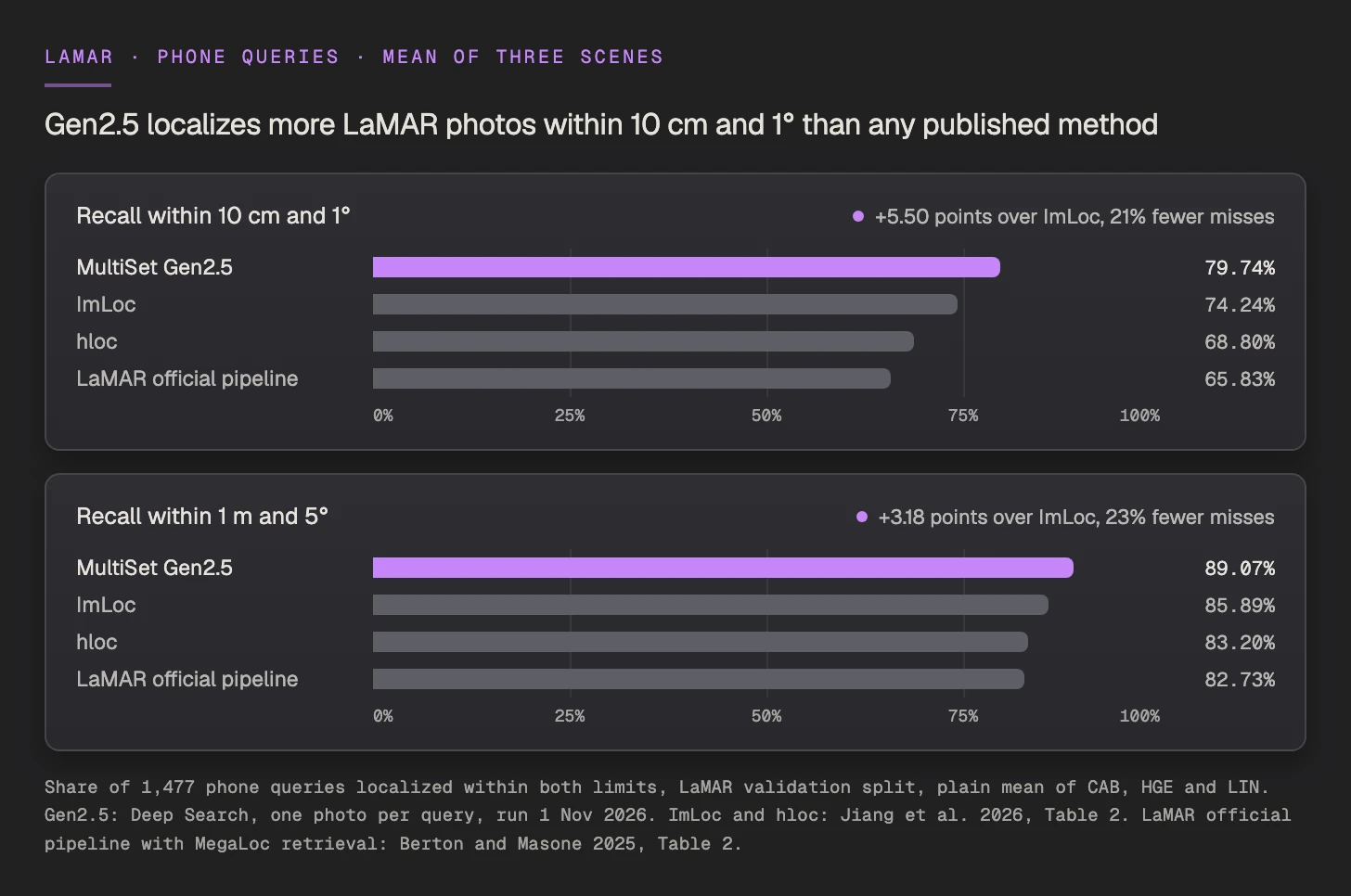
Recall on LaMAR, phone queries, validation split (%)
| Method | CAB 10 cm, 1° | CAB 1 m, 5° | HGE 10 cm, 1° | HGE 1 m, 5° | LIN 10 cm, 1° | LIN 1 m, 5° | Mean 10 cm, 1° | Mean 1 m, 5° |
|---|---|---|---|---|---|---|---|---|
| MultiSet Gen2.5 | 63.89 | 73.48 | 82.77 | 95.38 | 92.56 | 98.35 | 79.74 | 89.07 |
| ImLoc | 58.84 | 66.41 | 73.95 | 95.38 | 89.92 | 95.87 | 74.24 | 85.89 |
| hloc | 52.02 | 60.61 | 70.59 | 94.12 | 83.80 | 94.88 | 68.80 | 83.20 |
| LaMAR official pipeline | 47.0 | 60.4 | 67.2 | 92.9 | 83.3 | 94.9 | 65.8 | 82.7 |
Gen2.5's lead is widest in the scenes that repeat themselves. In HGE's symmetric halls it localizes 82.77% of queries within 10 cm and 1°, against ImLoc's 73.95%, which cuts ImLoc's misses by a third. In CAB's repeated office floors the lead is 5.05 points at the fine threshold and 7.07 at the coarse one. LIN, the outdoor old town, is the easiest scene for every method, and Gen2.5 still brings the share of queries missed at 1 m and 5° down from 4.13% to 1.65%.
HGE at 1 m and 5° is a tie. Both systems localize 95.38% of queries.

When Gen2.5 returns a pose on LaMAR, the median position error is 2.4 cm in CAB, 3.8 cm in HGE and 1.7 cm in LIN. Median rotation error runs from 0.15° to 0.41°.
All of this came from a single frame. In production, an app can also send four to six frames at once with the device's own tracking, which LaMAR's single-image protocol doesn't score, so we left it out.
LaMAR is public under CC BY-SA 4.0, ground truth for the validation split included, so anyone can check these numbers against their own run.
We tested Gen2.5 against Gen2 through our production API at two sites.
| Localized within 0.5 m | Outdoor industrial site | Indoor transit stations |
|---|---|---|
| Standard queries | +2.0% | +2.7% |
| Deep Search queries | +3.6% | +4.0% |
Across both sites, Deep Search on Gen2.5 found 48 poses that Gen2 missed, and Gen2 found 19 that Gen2.5 missed.
We also measured Gen2.5 on larger evaluation sets, each built around one real-world condition.
| Condition | Gen2.5 against Gen2 |
|---|---|
| Real field use at an outdoor industrial site | +12% more queries localized, at the same false-positive rate |
| Phone queries on a map captured at a different time | +11% more queries localized |
| Indoor transit stations and public buildings | +3.9% more correct localizations, 10% fewer wrong poses |
| Professionally scanned spaces | +3.9% more correct localizations, 10% fewer wrong poses |
| Correct place ranked first | 79.8% to 84.2% |
| Hardest cases from past regressions, correct place ranked first | 68.7% to 73.2% |

The two biggest gains come from field captures at the industrial site and from phones querying a map captured at a different time.
On our evaluation sets, median position error is still about 1 cm and median rotation error about 0.1°. The worst cases improve. On indoor transit maps, the 90th-percentile position error dropped from 6.5 cm to 4.0 cm. When Gen2.5 returns a pose, it's at least as accurate as Gen2's was.
We also re-engineered how a map is searched. The first few API calls on a map, the warm-up calls, now take up to 90% less time.
Integration. The same API, the same SDKs and the same request and response formats.
Coordinate frames. Maps keep their origins and alignment, so content anchored to a map stays where you placed it.
Capture. Map your space exactly as you do today.
API calls. A query counts the same number of calls on Gen2.5 as it did on Gen2.
Gen2.5 is live now on every plan, Free included, on MultiSet's public cloud. New maps are processed as Gen2.5 automatically, and existing cloud maps have already been upgraded, so there's nothing for you to do. Private-cloud, self-hosted and on-device deployments move to Gen2.5 on each environment's normal release cadence. Deep Search is the queryMode option on single-frame, panorama and multi-frame queries, and the Query Mode docs cover when to use it.
If you have questions, or results of your own to share, write to us at contact@multiset.ai.
Gen2.5 is the current generation of the MultiSet Visual Positioning System. It rebuilds how a query finds its place in a map, so more queries localize, especially in large spaces with look-alike areas, and the first calls on a map take up to 90% less time.
No. Existing maps on MultiSet's cloud have already been upgraded and new maps process as Gen2.5 automatically. Private-cloud, self-hosted and on-device deployments follow on their normal release cadence. The API, SDKs, request and response formats and coordinate frames are unchanged.
LaMAR is a public localization benchmark for augmented reality from ETH Zurich and Microsoft, published at ECCV 2022. It scores how many phone and headset photos a system localizes within strict distance and angle limits, across three large scenes in Zurich captured over about a year.
Averaged over the three scenes, Gen2.5 localized 79.74% of phone queries within 10 cm and 1° and 89.07% within 1 m and 5°, from a single photo per query. The best previously published results are 74.24% and 85.89%, from ImLoc.
Deep Search is MultiSet's higher-recall query mode. It searches more of the map before estimating a pose and is selected per request with the queryMode parameter. The LaMAR results use Deep Search on single frames.