VPS

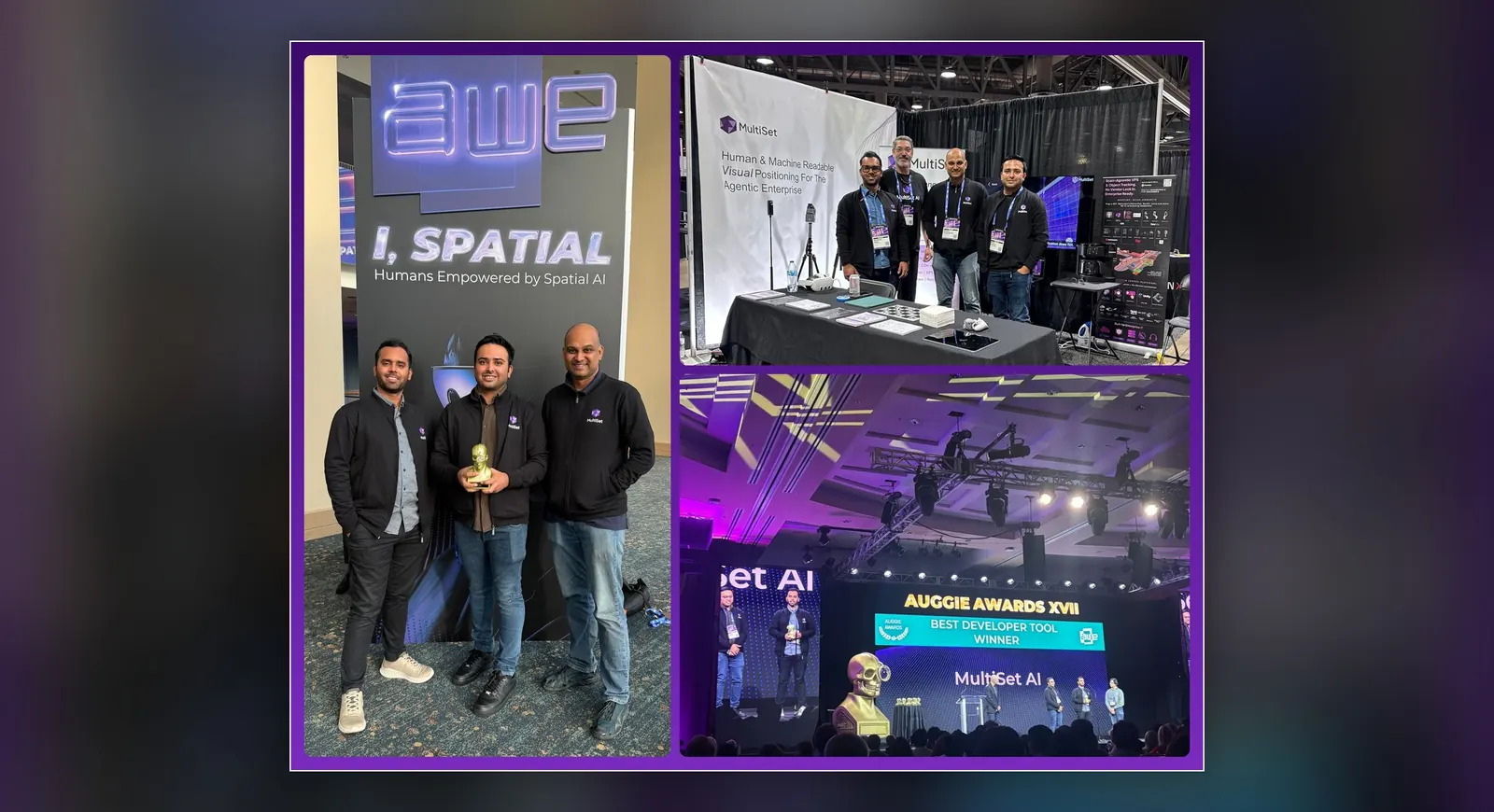
On June 17, at AWE USA 2026 in Long Beach, MultiSet AI won the Auggie Award for Best Developer Tool 2026.
Every vendor tells you their localization is accurate, their maps scale, and their SDK is a joy to use. You can't benchmark six platforms yourself. Most teams don't have the time, the test environments, or the reference hardware. So you're left choosing spatial infrastructure, the layer everything else in your deployment sits on, based on marketing pages.
MultiSet AI is the only visual positioning system independently ranked most robust in AREA's 2025 enterprise VPS testing and awarded Best Developer Tool at AWE 2026.
Two validation mechanisms. One judged by the people who build with these tools every day. One measured by researchers with test rigs and a published methodology. Different questions, same answer. That convergence is the story. Not the trophy.
| Validation | Who runs it | How it works | What it concluded |
|---|---|---|---|
| Auggie Awards 2026 | AWE, running the Auggies since 2010. 17th edition, 330+ entries. | Four gates over five months: eligibility screening of working products, industry-wide public voting, finalist selection via combined community and expert review, then an impartial expert judging panel. | MultiSet AI: Best Developer Tool 2026 |
| AREA Enterprise VPS Report 2025 | Augmented Reality for Enterprise Alliance. Research led by Ethar, Inc. | Hands-on comparative testing of commercial VPS platforms in mixed indoor-outdoor enterprise environments. | MultiSet ranked most robust VPS tested, with a perfect indoor performance score |
The Auggie Awards have run at AWE since 2010, which makes them the most recognized and longest-standing awards program in XR. 2026 was the 17th edition and another record year, with over 330 entries across 18 categories.
Winning one is not a matter of filling out a form. The process runs five months and four gates.
Gate 1: Eligibility. Every nomination must be a working product, released or majorly updated within the past year, demonstrated on video, and screened by AWE for functionality and integrity. Promotional sizzle reels get disqualified. Judges can request hands-on access to verify the product does what the submission claims. Vaporware doesn't survive this stage.
Gate 2: Public voting. Three weeks (April 24 to May 14) where the XR industry votes on the nominees. One vote per person, with automated or manipulated voting grounds for disqualification. This is where the community filters marketing from products people have actually used.
Gate 3: Finalist selection. Public voting scores are combined with a preliminary expert review to name finalists, announced May 21. Community support alone doesn't get you through; neither does an expert nod without community backing.
Gate 4: Expert judging. From May 21 to June 10, a panel of impartial judges drawn from AWE's Advisory Council rates the finalists against three published criteria: quality and originality, user experience, and impact on how people work. The rules bar any company that employs a judge from competing, and judges must recuse from submissions where impartiality is in question.
The Best Developer Tool field this year reflected how seriously the category is contested. The finalist field included Snap's Lens Studio, Zappar's Mattercraft, Virtualware's VIROO Studio, STYLY's open source LBE project, and 3lbXR's GroKit Core: some of the strongest developer tooling in XR. The full finalist gallery is on the Auggies site.
Why does winning that gauntlet matter more than a features comparison? Because developer experience is the adoption metric for infrastructure. A VPS can post great accuracy numbers in a controlled demo and still die in production because the SDK fights you, the docs are thin, or the ingest pipeline only accepts one proprietary capture format. Developers vote with their integration hours long before procurement votes with a PO.
Every community vote came from someone building something real: warehouse navigation on smart glasses, valve-finding in a pharma facility, AMR localization over ROS 2, WebXR wayfinding with no app install. When those people push you through public voting, and an impartial expert panel then confirms it, the platform has survived contact with both actual jobsites and actual scrutiny.
That's the part of this award I care about.
Community recognition is one kind of evidence. Instrumented testing is another. In 2025, the Augmented Reality for Enterprise Alliance (AREA) published its Enterprise Visual Positioning Systems research report, with testing conducted by Ethar, Inc.
The methodology is worth understanding, because it's the closest thing this category has to a public benchmark. The researchers interviewed AREA member organizations (the membership includes Boeing, Ericsson, ExxonMobil, Lockheed Martin, and other enterprises running AR at industrial scale) to define real use cases. They then compiled a list of commercial and open-source VPS platforms, selected the vendors that met enterprise AR criteria for hands-on testing, and evaluated each in a mixed indoor-outdoor setting with structured interiors, transitional thresholds, landscaped areas, and dynamic lighting. They scored localization accuracy, latency, environmental resistance, interference handling, performance in changing environments, API functionality, and the quality of documentation and support.
In that testing, MultiSet earned a perfect score for indoor performance. On interference handling, the researchers wrote that MultiSet "performed brilliantly" in reaction to changes in the environment. Moving objects and artifacts introduced into scenes had negligible impact on localization. Across the evaluated dimensions, MultiSet ranked as the most robust VPS in the study.
Read the report before you shortlist anyone, including us. The methodology is repeatable, and AREA published it so members can run the same tests in their own facilities.
MultiSet released a Gen2 VPS in June 2026, exactly a year after the AREA benchmark, further compounding its category leading advantage.
Here's the thing about winning both. These programs measure completely different failure modes.
The AREA testing catches the platform that demos well but drifts when a forklift crosses the frame. The Auggie catches the platform that benchmarks well but takes six weeks to integrate. A VPS can fail either test independently. Passing both isn't two press releases. It's evidence that the same architectural decisions hold up under lab conditions and under developer deadlines.
Those decisions, for us, are consistent and public.
Scan-agnostic ingestion. We build VPS maps from whatever reality capture you already own: E57 point clouds, LiDAR, Matterport exports, iPhone scans, Gaussian splats, 360 video from an Insta360. No proprietary capture rig, no re-scanning your portfolio to fit a vendor's pipeline. That breadth isn't a feature list. It's an architectural commitment, and it shows up in developer experience as "we started with the scans we had on a hard drive."
Deploy anywhere. Public cloud, dedicated cloud, private cloud inside your VPC, fully on-device. The same maps, the same API. Enterprise reviewers score this as compliance. Developers experience it as not rebuilding the integration when security review changes the deployment target.
Cross-platform by default. Unity, native iOS and Android, WebXR, Meta Quest, Meta Ray-Ban smart glasses, ROS 2. One spatial map serving a technician's phone, a visitor's browser, and a robot's nav stack. The map is the product; the device is a client.
Accuracy that survives the field. Sub-5cm median localization, holding up across lighting changes, moved furniture, and multi-floor facilities. That's the number the AREA researchers were probing when they introduced interference into scenes, and it's the number a Fortune 100 industrial customer now depends on in private cloud production, where technicians find maintenance assets 2.5× faster and mean time to repair on critical incidents dropped 4×.
No report and no award replaces your own pilot. Honest limits.
The AREA testing was conducted in one representative mixed environment. Your facility has its own lighting, its own reflective surfaces, its own rate of change. A platform that scored well in the study can still need tuning in your space, and the report itself notes that environmental conditions significantly impact every system tested. Plan for localization failures with fallback strategies. The researchers said it; we agree with it; anyone who tells you otherwise is selling a demo.
Awards have a recency bias too. The Auggie reflects the 2025-2026 developer experience. Platforms evolve. What the pairing of a measured benchmark and a community vote gives you is not a guarantee. It's a prior. Start your evaluation from independently validated platforms, then let a two-week pilot in your own space make the final call.
If you're building a VPS shortlist, the rollout I like:
Weeks 1: evidence review. Read the AREA report methodology and results. Note which platforms were tested at all; absence from independent testing is itself a data point. Check developer-facing signals: docs depth, SDK breadth, time-to-first-localization in public quickstarts.
Week 2: pilot in your space. Map one zone with capture hardware you already own. Test localization at the times of day your teams actually work. Introduce the interference your environment actually produces: pallets, people, vehicles, seasonal light.
Week 3: production shape. Validate the deployment topology security will actually approve, the device mix operations will actually issue, and the re-scan workflow facilities will actually follow with Map Versioning. This is where developer experience stops being abstract.
If you only remember one thing from this article, it's this: vendor claims are hypotheses. Independent testing and developer consensus are evidence. Demand both.
MultiSet AI won the Auggie Award for Best Developer Tool at AWE USA 2026 in Long Beach on June 17, 2026. AWE described the winning platform as a scan-agnostic visual positioning system delivering centimeter-accurate 6-DoF localization and object tracking across multi-floor indoor and outdoor environments, deployable on cloud or device.
The finalists were MultiSet AI, Snap's Lens Studio, Zappar's Mattercraft, Virtualware's VIROO Studio, STYLY's open source project for location-based entertainment, and 3lbXR's GroKit Core.
The Auggie Awards are the XR industry's most recognized awards program, presented at AWE (Augmented World Expo) since 2010. The 2026 edition drew over 330 entries across 18 categories. Winners pass four stages: eligibility screening of working products, industry-wide public voting, finalist selection combining community votes with expert review, and a final judging panel of impartial experts rating finalists on quality, user experience, and impact.
The AREA (Augmented Reality for Enterprise Alliance) 2025 Enterprise VPS research report, with hands-on testing conducted by Ethar, Inc., identified MultiSet AI as the most robust VPS among the commercial platforms tested, including a perfect indoor performance score. The report and its repeatable methodology are available through AREA.
No. Independent validation narrows your shortlist; it doesn't replace testing in your own environment. Lighting, layout, and rate of change vary by facility. We recommend a two-week pilot mapping one zone with your existing capture hardware before any production commitment. You can start free on the developer portal.
Infrastructure earns trust slowly. The AREA researchers earned it with test rigs and a published methodology. The developers who voted in the Auggies earned it with integration hours on real deployments. We're grateful for both, and we know exactly what the recognition obligates us to do next: keep the accuracy, keep the ingest formats open, keep the deployment options honest, and keep shipping tools developers would vote for again.
Start mapping free → developer.multiset.aiBook a demo → [Calendly link]
Related: AWE's official winners announcement · AWE press release · AREA VPS Report · Map Versioning · On-Device VPS · 360 Video to VPS